Every agreement creates opportunities, obligations, and consequences.
I’ve learned that the strongest decisions are rarely made by focusing on compensation alone. They’re made by understanding the complete picture, from performance obligations and exclusivity provisions to termination rights and the long-term impact a contract may have on a career.
From the Desk of Fletcher N. Smith III
Throughout my career, I’ve been asked countless questions about contracts, negotiations, NIL, career decisions, financial planning, and the business of sports.
Many of those conversations happen after an athlete has already signed an agreement. I’ve often found myself wishing they had happened sooner.
That’s one of the reasons I created Blueprint Insights.
My goal isn’t to replace legal, tax, or financial advisors. It’s to help athletes, families, coaches, and executives ask better questions before they make important decisions. Because the quality of the questions you ask often determines the quality of the decisions you make.
Over nearly three decades representing professional athletes, coaches, and executives, I’ve learned that careers are rarely defined by a single contract. They’re shaped by a series of thoughtful decisions made over time.
Some articles will focus on negotiations. Others will explore NIL, revenue sharing, taxes, financial planning, leadership, and the business of sports.
All of them share one purpose:
To help you make informed decisions before the ink dries, not after.
— Fletcher N. Smith III
Founder & President
Blueprint Sports Management Group
Opening Perspective
After nearly three decades representing athletes, I’ve learned something that still surprises people.
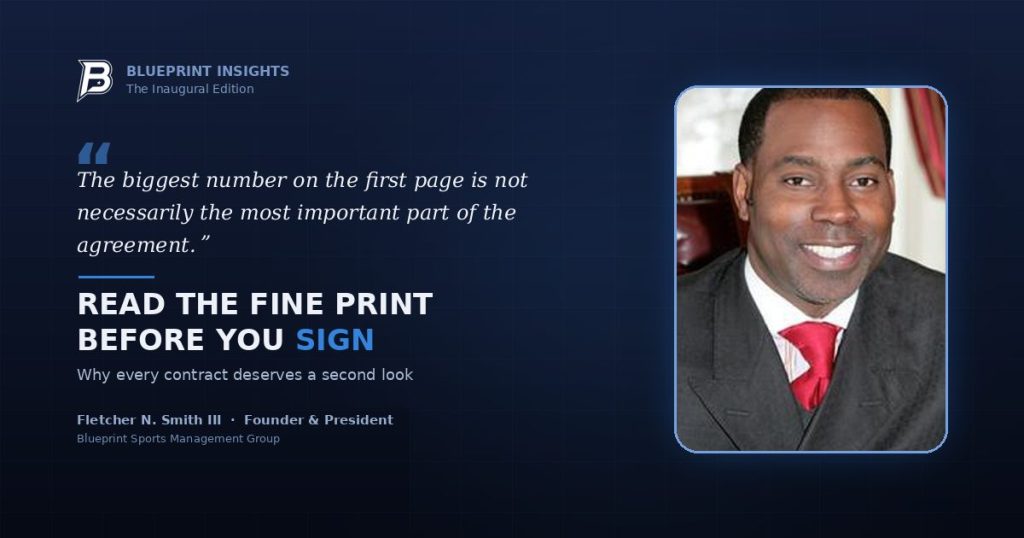
“The biggest number on the first page is not necessarily the most important part of the agreement.”
Whether I’m reviewing an NIL agreement, a revenue-sharing agreement, a professional playing contract, a coaching agreement, or a marketing partnership, my attention immediately shifts beyond the compensation.
Every agreement creates opportunities, obligations, and consequences. Compensation is only one part of the story. The true value of a contract is understanding how it affects your rights, your responsibilities, and your future.
Contracts aren’t tested on signing day.
They’re tested when something unexpected happens.
That’s why every contract deserves a second look.
Contracts Don’t Predict the Best Days. They Prepare for the Difficult Ones.
The strongest agreements don’t simply describe what everyone hopes will happen.
They explain what happens if something changes.
Good contracts don’t create mistrust.
They create clarity.
The Headline Number Is Only Part of the Story
Compensation matters, but the true value of an agreement is determined by what it requires, what it protects, what rights it grants, what obligations it creates, and what happens if circumstances change.
Every Contract Allocates Risk
Every agreement answers one important question:
If something changes, who bears the risk?
Good negotiations aren’t just about maximizing compensation. They’re about allocating risk fairly.
Blueprint Contract Review Checklist
Questions Every Athlete and Family Should Ask Before Signing
1. What Type of Compensation Am I Receiving?
- Is this Revenue Sharing, NIL compensation, or both?
- If both, how are they distinguished?
- Do different obligations apply?
- Are there restrictions on pursuing additional opportunities?
Blueprint Perspective: Every dollar isn’t earned the same way. Understanding the source of your compensation is just as important as understanding the amount.
2. Compensation and Guarantees
- What is the exact payment schedule?
- Monthly, installments, or lump sum?
- Is any portion deferred?
- Is the agreement guaranteed?
- What percentage is protected?
- What happens if I am injured, transferred, released, or circumstances change?
- Can compensation be reduced or terminated?
A contract should tell you not only how much you’ll be paid, but under what circumstances you’ll actually receive it.
3. Performance Incentives
- What incentives exist?
- How are they earned?
- Who determines eligibility?
- When are they paid?
- Are earned incentives guaranteed?
Know the difference between guaranteed compensation and potential compensation.
4. What Am I Expected to Do?
- Appearances
- Social media
- Camps
- Interviews
- Promotional events
- Travel
- Community obligations
Know exactly what you’re agreeing to.
5. What Happens If Circumstances Change?
- Injury
- Transfer
- Eligibility
- Coaching changes
- Termination rights
- Continuing obligations
6. What Rights Am I Giving Away?
- Understand how your name, image, likeness, and intellectual property may be used.
7. Who Is Looking Out for My Interests?
- The school has advisors.
- The company has lawyers.
- The brand has representatives.
- Who is protecting yours?
Common Mistakes I See
Chasing the Headline Number
The largest offer isn’t automatically the best opportunity.
Assuming Every Contract Is Standard
There is no such thing as a standard agreement when your career is involved.
Waiting Too Long to Ask Questions
The best questions are asked before the signature, not after.
Signing Before Building the Right Team
Representation should never begin with a crisis. The strongest advisory relationships are built long before they’re needed.
Blueprint Perspective
Throughout my career, I’ve never measured success by how many contracts I’ve negotiated.
I’ve measured it by how well those agreements served the people who signed them.
Contracts come and go.
Careers evolve.
Relationships endure.
Because the best representation isn’t measured by getting a deal done.
It’s measured by helping someone build a career.
Blueprint Takeaways
- Don’t judge a contract by the first page.
- Understand the opportunities and the obligations.
- Ask questions until every provision makes sense.
- Preparation is always less expensive than correction.
- Great contracts don’t just create opportunities, they protect careers.
About the Author
Fletcher N. Smith III is the Founder and President of Blueprint Sports Management Group. An attorney and NFLPA-certified contract advisor with nearly three decades of experience, Fletcher advises professional and collegiate athletes, coaches, executives, and families on contract negotiations, NIL strategy, career development, and long-term planning.